
The Digital DarkTM Factory MANIFESTO
A Framework for the Future of Operations
What is a 'Digital' Dark Factory?
Any digital production process where there are no mandatory humans in the loop. This includes most knowledge work of the future. Think documents, files, communications and labor that is currently performed on digital devices such as phones or computers.
The Four Stages of Operational Maturity
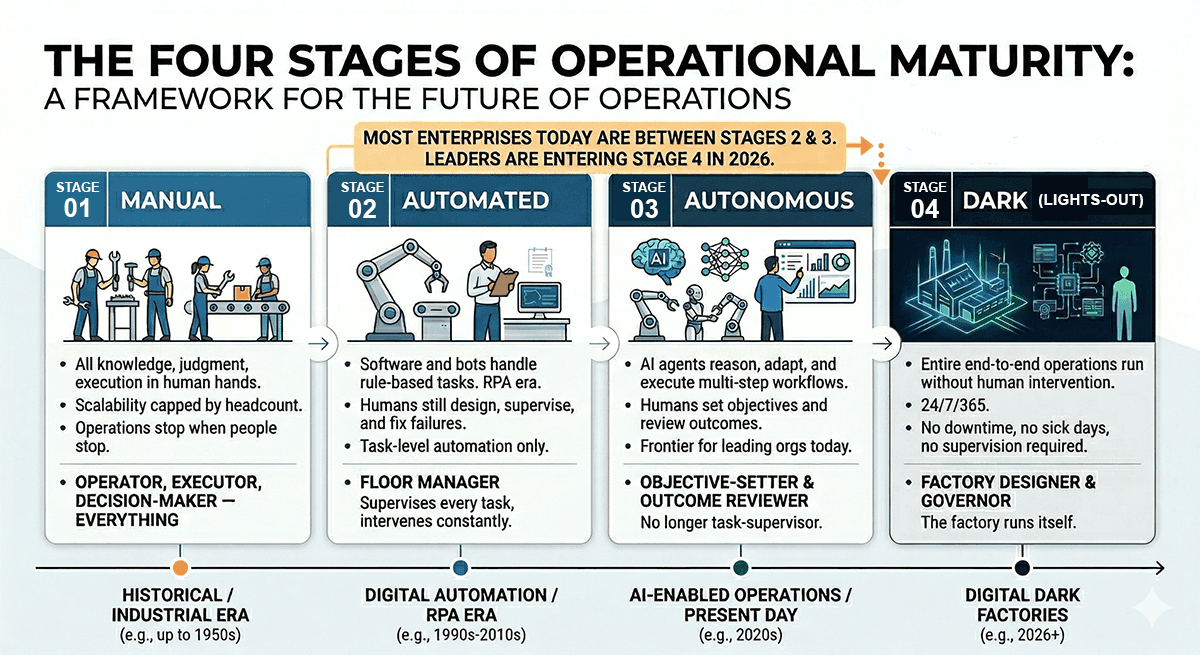
Most enterprises today are somewhere between stages 2 and 3. Leaders are entering stage 4 in 2026.
Manual
All knowledge, judgment, and execution in human hands. Scalability capped by headcount. Operations stop when people stop.
Human Role: Operator, executor, decision-maker — everything.
Era: Historical / Industrial Era (up to 1950s)
Automated
Software and bots handle rule-based tasks. RPA era. Humans still design, supervise, and fix failures. Task-level automation only.
Human Role: Floor manager. Supervises every task, intervenes constantly.
Era: Digital Automation / RPA Era (1990s-2010s)
Autonomous
AI agents reason, adapt, and execute multi-step workflows. Humans set objectives and review outcomes. Frontier for leading orgs today.
Human Role: Objective-setter and outcome reviewer. No longer task-supervisor.
Era: AI-Enabled Operations / Present Day (2020s)
Dark (Lights-Out)
Entire end-to-end operations run without human intervention. 24/7/365. No downtime, no sick days, no supervision required.
Human Role: Factory designer and governor. The factory runs itself.
Era: Digital Dark Factories (2026+)
I. The Factory That Needed No Light
In 1982, a factory opened in Oshino, Japan that changed the definition of what a factory could be. Inside its walls, FANUC — the Japanese robotics and CNC manufacturer — had built something that had never existed before: a facility where robots built other robots, unattended, in complete darkness. No workers arrived for morning shift. No lights switched on. No supervisors paced the floor. The machines worked through the night with no one watching, no one waiting, no one needed. That factory ran for thirty days at a stretch without a single human being present on the production floor.
To the engineers who built it, this was a technical achievement. To the rest of the world, it was something closer to a philosophical statement. The dark factory did not just produce more robots per unit of labor. It redefined the relationship between human effort and operational output. It said, in the most concrete terms imaginable: this work does not require a person to be present.
Manufacturing spent the next four decades chasing that principle. Lights-out facilities spread. Robotic assembly systems became standard. The factory floor went from a place where skilled craftspeople shaped raw material with their hands to a place — and eventually, to many places — where machines ran with minimal human presence. The workers who remained were not replaced by nothing. They were elevated into roles that machines could not yet perform: designing the systems, governing the outputs, improving the models. The work changed. The scale exploded.
That same transformation is now arriving for knowledge work. Not as a distant possibility. Not as a researcher's thought experiment. As a competitive reality that is already reshaping the operational landscape of enterprise business. The dark factory — the operational state where entire business processes run end-to-end without human intervention — is no longer a manufacturing metaphor. It is becoming the defining architecture of enterprise operations in the decade ahead.
Consider what the typical enterprise has actually built with its automation investments. A portfolio of bots that mimic human clicks. A constellation of workflow tools that connect APIs when a trigger fires. An AI assistant that drafts emails and summarizes documents. These are genuine improvements. They are also, in the context of what is now possible, table stakes dressed up as strategy.
The enterprises that will define the next decade are not those that automate tasks more efficiently. They are the ones that eliminate the need for a human to be present in the operational loop altogether. Not for every decision — strategic judgment remains irreducibly human. But for the vast operational territory between strategic objective and measured outcome: the emails sent, the records updated, the reports pulled, the exceptions triaged, the follow-ups dispatched, the data reconciled. That territory is enormous. It consumes the majority of enterprise operational labor. And it is, today, technically ready to run in the dark.
The companies that figure out how to go dark will not simply be more efficient than their competitors. They will be structurally different. They will operate at scales and speeds that human-dependent organizations cannot match, not because they work harder, but because the physics of their operation have fundamentally changed. They will be faster. Cheaper. Inexhaustible. And their competitors — still staffing the lights, still routing through human queues — will not be able to compete on the same terms, regardless of how talented their people are.
This is not incremental improvement. This is a categorical shift in how enterprises operate.
What follows is a manifesto for the era of autonomous operations. It is an argument, grounded in history and architecture, for why the dark factory is the inevitable next stage of enterprise evolution — and a call to every organization that intends to be competitive in the decade ahead: Go dark.
II. The Automation Trap — Why Current Approaches Are Dead Ends
The global enterprise automation market will exceed $25 billion this year and is projected to grow to more than $71 billion by 2031. That is not a niche technology segment. That is infrastructure-level investment. And it is, in an important sense, exactly the problem.
A large market built on the wrong paradigm is not a success story. It is a monument to a ceiling. When billions of dollars of enterprise capital are invested in approaches that are structurally incapable of reaching the destination — autonomous, lights-out operations — those investments become technical debt at civilizational scale. They lock organizations into operational architectures that will require dismantling before the next era can begin.
The current automation market, for all its genuine value, has four dominant categories that share a common architectural limitation: they automate inside the existing operational paradigm rather than replacing it. Understanding why each falls short is essential to understanding what the dark factory actually requires.
RPA — Robotic Process Automation
The concession must come first: RPA solved a real problem. In an era before AI, enterprises needed a way to automate the most repetitive, rules-based tasks — logging into systems, copying data between fields, filling out forms, extracting structured information from screens. UiPath and Automation Anywhere built billion-dollar companies on the promise of a software robot that could mimic the most routine human behaviors. For organizations drowning in manual data entry and repetitive processing tasks, RPA delivered meaningful relief.
But mimicry is not intelligence. RPA bots are, at their core, sophisticated screen-scrapers executing rigid, pre-programmed scripts. They have no understanding of what they are doing — only where to click. When a UI changes, the bot breaks. When an exception occurs, the bot stops. When the business process evolves, the bot requires a developer to rewrite it from scratch. The result is a maintenance burden that frequently rivals the original labor cost being eliminated.
The deeper problem is architectural. RPA operates at the task level. It can fill out a form. It cannot manage an operation. It can extract data from a screen. It cannot reason about what that data means or what should happen next. RPA is robotic in the worst sense of the word: mindless repetition without understanding. The dark factory does not run on bots that break when the button moves. It runs on agents that understand why the button exists.
Workflow Orchestration — Zapier, Make.com, n8n
Workflow orchestration tools represent a genuine leap forward. Zapier democratized API integration for non-developers. Make.com brought visual, no-code pipeline building to business operators. n8n gave technical teams self-hosted flexibility and open-source transparency. The market has validated this category emphatically — and these tools genuinely serve important functions in the modern enterprise technology stack.
But infrastructure is not a factory. Workflow orchestration tools are, at their core, sophisticated plumbing. They move data from point A to point B when a trigger fires. They connect APIs. They route information through deterministic pipelines. And they do all of this extraordinarily well — within a fixed, pre-defined logic that a human built in advance.
The limitation is structural. Trigger-based, deterministic pipelines cannot reason. They cannot adapt. They cannot handle the ambiguous, the unexpected, or the contextually complex. When an edge case falls outside the predefined flow, the workflow either fails silently or routes to a human for intervention. Every exception is a system failure. Every new use case requires a new pipeline. Organizations end up building an ever-expanding map of 'if this, then that' branches that eventually collapses under its own weight. You are not building an operation. You are building plumbing. Plumbing is necessary. Plumbing is not sufficient.
AI Agent Platforms — Lindy AI, Relevance AI, Salesforce Agentforce
AI agent platforms mark the beginning of the right conversation. Tools like Lindy AI and Relevance AI recognize that the future of work is not about automating individual tasks but about deploying autonomous workers — AI entities capable of reasoning, acting, and completing multi-step objectives without constant human oversight. Salesforce Agentforce brings enterprise credibility and distribution to this emerging category. These platforms are asking the right question: what if AI could work like an employee?
Asking the right question is not the same as building the right answer. The fundamental limitation of current AI agent platforms is that they deploy individual workers rather than integrated operations. An operation is not a collection of individual contributors. An operation is a coordinated system where inputs flow through structured processes, roles are defined with governance and accountability, and outputs are measured against operational standards. Hiring talented freelancers is not building a factory. You can staff an entire office with capable individual agents and still have chaos — because talent without system is noise. These platforms are powerful additions to existing paradigms. The dark factory requires a new paradigm entirely.
Developer Frameworks — LangChain, CrewAI, AutoGen
Developer frameworks have done something critical: they have proven that multi-agent orchestration is technically possible. LangChain normalized the concept of chaining language model calls. AutoGen demonstrated that multiple AI agents could collaborate on complex tasks. CrewAI showed that role-based agent crews could tackle sophisticated workflows. For the research community and technically sophisticated teams, these frameworks are foundational contributions to the field.
But maximum flexibility is not a product. Raw toolkits built for engineers offer infinite customizability and zero operational governance. There are no deployment guardrails, no enterprise access controls, no audit trails, no handler-based boundaries, no safe progression from human oversight to full autonomy. Everything must be built from scratch — the orchestration logic, the memory architecture, the permission model, the monitoring infrastructure, the escalation protocols. Months of engineering work to build what should deploy in days.
Telling an operations leader to 'go use LangChain' is like handing someone a box of engine parts and calling it a car. The parts are real. The car does not exist yet. For enterprises that need to transform operations — not prototype them — developer frameworks are a starting point that becomes a permanent construction zone. The dark factory does not run on perpetual engineering sprints.
"The automation market is enormous. The paradigm is wrong. We have built an ever-larger scaffolding on a foundation that cannot support the building we actually need."
III. The Manufacturing Moment — Why 'Dark' Is Inevitable
For most of human history, manufacturing meant craftspeople. A cobbler made a shoe from start to finish. A blacksmith forged each piece individually. Every product was the output of a single skilled worker who held the entire process in their hands. This was admirable. It was also slow, expensive, and fundamentally unscalable.
Then Henry Ford changed everything. The assembly line did not replace skilled workers with unskilled ones. It reorganized the relationship between human effort and operational output. Each worker became responsible for one precise step in a coordinated sequence. The result was not a degradation of manufacturing — it was an explosion of it. Cars went from luxury items to mass-market products in a decade. The economics of production changed permanently. Those who could not adapt to the new model did not compete at a slightly lower level. They ceased to exist.
The assembly line evolved. Robotics entered the factory floor. Computer-controlled machines began handling the most repetitive, precision-critical steps. Ford gave way to Toyota, to lean manufacturing, to Six Sigma, to just-in-time inventory. The factory became a system — not just a sequence of human steps but an engineered organism designed to minimize waste, maximize throughput, and respond dynamically to demand.
Each transition was disruptive. Each transition was also inevitable. And each transition left behind the companies that confused the tools of the previous era for permanent competitive advantages.
The steam engine did not just speed up production. It redefined what a factory could be and where it could exist. Electricity did not just replace steam. It rewired the entire logic of industrial organization — where factories could be built, how shifts were structured, what scale was possible. Computers did not just automate ledgers. They eliminated entire categories of work and created entirely new industries that had not previously existed. Every one of these transitions looked, to those inside the previous paradigm, like a productivity improvement. It was never just that. It was always a categorical shift in the rules of competition.
We are inside that kind of moment right now. Not a software upgrade. Not a productivity improvement. A civilizational transition in how knowledge work gets done.
FANUC's iDCell facilities in Japan run with the lights literally off — robots manufacture components for extended periods with no human workers present on the production floor, accumulating operational data continuously, learning, adjusting, and optimizing without pause. Tesla's Gigafactories are not assembly plants with robots inside them. They are software systems that happen to produce physical objects. Every weld, every torque specification, every battery cell placement is a programmable output — adjustable, versionable, deployable like code.
The underlying principle extends far beyond manufacturing: the factory doesn't run on more engineers. It runs on engineers who can think clearly about what the factory should do. That sentence is the entire argument. The constraint on autonomous operations is not compute. It is not software. It is not infrastructure. The constraint is strategic clarity. Organizations that can define what the factory should do — with sufficient precision to delegate it completely — are the organizations that can run it in the dark. Organizations that cannot define it clearly enough will continue to require human presence at every step, not because the step requires a human, but because no one has yet thought clearly enough about what that step actually is.
This is the manufacturing moment for knowledge work. The question is not whether it arrives. It has already begun. The question is whether your organization will be among those that designed the factory — or among those watching from outside it, still staffing the lights.
IV. The Competitive Stakes — Go Dark or Get Disrupted
The argument for autonomous operations is not only architectural. It is competitive. The enterprises making this transition are not merely becoming more efficient. They are building structural advantages that their competitors will find, in time, impossible to overcome through effort alone. Three of these advantages deserve precise examination.
Cost Compression at Scale
The numbers are not theoretical. AI-driven automation is delivering cost reductions of up to 93% in specific operational domains — not 15%, not 30%, but structural elimination of entire cost categories. A competitor who achieves it can undercut your pricing at a margin you cannot match, not because they are more efficient, but because they are operating on a fundamentally different economic model. They are not running a better version of your business. They are running a different kind of business that happens to serve the same customers.
When the cost of executing an operation approaches zero — when an AI agent can do in seconds what a human team did in hours, across every timezone, continuously — the economics of the business reshape themselves entirely. Gross margins expand. Headcount decouples from revenue. Scale no longer requires proportional staffing. This is not optimization. This is the elimination of an entire cost structure and its replacement with something categorically different.
Speed as a Structural Moat
Same-day delivery was once a premium differentiator in e-commerce. It is now table stakes. The organizations that built the infrastructure for same-day delivery while their competitors debated whether it was necessary now own a structural advantage that cannot be matched by effort alone. You cannot out-hustle a fulfillment network. You can only build one.
The same dynamic is emerging in every domain where autonomous operations create speed advantages. When a competitor can close a support ticket in seconds, generate a compliant contract in minutes, or complete a procurement cycle in hours — and you are still routing through human queues that take days — you are not losing on service quality. You are losing on the physics of the operation. E-commerce did not beat retail by being better. It beat retail by operating on a different architecture.
Zero Downtime as Competitive Baseline
Autonomous systems do not fatigue. They do not take sick days. They do not have good days and bad days. They do not lose institutional knowledge when someone resigns. They do not require onboarding when the workflow changes. They do not make errors at 4pm that they would not make at 9am.
Zero downtime is not a technology feature. It is a competitive posture. Organizations that achieve operational continuity through autonomous systems are not simply more reliable — they are redefining what reliability means in their industry. And once an industry's reliability baseline shifts upward, every organization operating below it is not just underperforming. It is failing on the terms the market now takes for granted.
The window to act is real, and it is not permanently open. First-mover advantages in operational infrastructure compound. An organization that achieves dark operations in its customer success function this year will have a year of learning, optimization, and institutional knowledge by the time its competitors begin to explore the same capability. The gap does not stay the same. It widens.
Can your operations run in the dark? Not yet — for most enterprises. But the organizations that begin building toward that answer today will find themselves in a categorically different competitive position in twenty-four months. Those that wait for the category to mature before moving will find the category already occupied.
V. The Architecture of Autonomous Operations
The dark factory is not a feature. It is not a setting you toggle. It is an operational architecture — a coherent set of structural principles that, taken together, enable an enterprise to run end-to-end business processes without requiring human presence in the execution loop. Understanding that architecture is the prerequisite to building it.
What follows are not product specifications. They are architectural principles — the organizational and technical components that any autonomous operations platform must provide, and that any enterprise must internalize, to achieve lights-out operation.
Component 1: The Dark Agent
A Dark Agent is an autonomous AI system capable of executing multi-step operational tasks without requiring human initiation, oversight, or approval at each step. It is not a chatbot that responds when asked. It is not a workflow trigger that fires when a condition is met. It is an agent that receives a defined objective, constructs a plan to achieve it, executes that plan across tools, systems, and data sources, and reports outcomes — autonomously.
A Dark Agent can write and send communications, update CRM records, pull and analyze reports, make scheduling decisions, escalate only when genuinely necessary, and reassess when conditions change. It operates within boundaries set by its handler — but within those boundaries, it acts. It decides. It executes. It delivers. The Dark Agent is not a replacement for human judgment at the strategic level. It is the replacement for human labor at the operational level. That distinction is essential.
Component 2: LightsOut Mode
LightsOut Mode is the operational state in which a Dark Agent — or an orchestrated network of Dark Agents — execute an entire business function end-to-end without any human touchpoint in the workflow. Humans set the objective. Humans define the constraints. Humans review the outcomes (or not). But the work itself — the dozens or hundreds of micro-decisions and micro-actions between objective and outcome — happens autonomously, invisibly, continuously.
This is what it means to run operations in the dark. Not 'mostly automated' with a few human checkpoints. Not 'AI-assisted' with humans confirming every action. End-to-end execution with human involvement limited to design, governance, and outcome review. The factory runs. The lights stay off.
Component 3: Natural Language Execution Plans
The barrier to enterprise automation has always been technical. Workflows require developers. Bots require programming. Pipelines require architects. The result is that operational transformation has been bottlenecked by the supply of engineering talent rather than limited by the ambition of business operators.
Natural Language Execution Plans eliminate that barrier entirely. In a dark factory, operations are defined in plain English. A handler — a business operator, not a developer — describes what needs to happen: the objective, the constraints, the acceptable outcomes, the escalation triggers. The system translates that description into an executable plan, assigns it to the appropriate agents, and runs it. No code. No flowcharts. No drag-and-drop builders. Language — the oldest and most natural interface humans have ever used — powerful enough to orchestrate enterprise operations at scale.
Component 4: Handler-Based Access Control
Autonomous operation without governance is not innovation. It is liability. The dark factory does not mean unsupervised — it means systemically supervised rather than manually supervised. Every Dark Agent operates within a defined permission envelope set by its handler. The handler defines what the agent can access, what it can act on, what it can communicate, what it must escalate, and what it is strictly prohibited from doing.
This is not a suggestion framework. It is a hard constraint architecture. Agents cannot exceed their handler's permissions. Every action taken by a Dark Agent is traceable, permissioned, and attributable to a named human authority. The enterprise gains speed without sacrificing control. It gains autonomy without sacrificing accountability. The dark factory is not a black box. It is a glass box — one that happens to run without anyone standing inside it, which also gives humans complete visibility into what happened, is happening, and will happen, in as much granularity or broad strokes as is desired.
Component 5: The Sidekick-to-Dark-Agent Progression
Organizations do not flip a switch and go fully autonomous overnight. They progress. They begin with Sidekick mode — a human-in-the-loop model where the AI assists, suggests, drafts, and prepares, but a human confirms every consequential action. Trust is built. Patterns are established. The handler learns how the agent reasons, and the agent learns the boundaries of its handler's expectations.
Over time, as confidence accumulates, the handler expands the agent's autonomous range — first to low-risk decisions, then to higher-volume tasks, then to full execution authority within defined parameters. The progression from Sidekick to Dark Agent is not a technical upgrade. It is a trust architecture. It is how organizations safely adopt autonomous operation without reckless exposure. It is the on-ramp to the dark factory — the controlled, intentional, observable path from human-operated to lights-out. But that doesn't mean going slow. Quite the opposition. Rather than starting with one 'task' that gets produced in the dark, instead activate any normally time-consuming process, and let the Dark Agents go at it in a sandbox (temp files, temp folders, hidden pages, etc). After multiple successful runs, trust accumulates quite quickly.
VI. The Human Question — What Happens to People?
This question must be answered directly. Not with reassuring platitudes. Not with defensive deflection. Not with the kind of hollow optimism that treats genuine disruption as a branding opportunity.
There will be massive job loss. A dark factory works without humans — how could there not be? This is not a comfortable truth, but it is the truth. The nature of work does not merely change; for many roles, work disappears entirely. Some new roles will emerge, but not enough to absorb what is lost. The transition will create genuine hardship for real people — and any honest account of autonomous operations must acknowledge that before anything else.
The humans who thrive in the autonomous enterprise are not those who execute operations. They are those who design, govern, and continuously improve them. Four new categories of human contribution become essential in the dark factory:
Factory Designers
Are the strategists and architects who design the operational systems themselves. They determine what gets automated, how agents are structured, what objectives are set, and what outcomes are acceptable. This is not a technical role. It is a strategic one — and it requires a depth of operational understanding that most organizations have not yet developed. The Factory Designer is the person who decides what the factory does. That decision is the most consequential in the enterprise.
Operations Architects
Translate strategic intent into executable natural language plans. They define workflows, set constraints, write execution plans, and continuously refine them based on outcomes. Where developers once built automations in code, Operations Architects build them in language — but the precision required is no less demanding. Ambiguity in a natural language plan produces the same errors as ambiguity in code.
Agent Handlers
Are the governors. They own the permission envelopes of specific agents, monitor agent behavior, interpret escalations, and make the judgment calls that agents are not authorized to make. Think less like managers and more like air traffic controllers — responsible not for doing the work, but for ensuring the system does it safely, within defined parameters, with appropriate escalation when conditions change.
Quality Auditors
Review outcomes, identify drift, spot errors, and feed intelligence back into the system. They ensure that autonomous execution does not calcify into autonomous mediocrity. The dark factory that runs without human oversight of its outputs eventually optimizes toward the wrong objectives. Quality Auditors are the mechanism that prevents the factory from running brilliantly in the wrong direction.
This is the industrial revolution parallel that people cite for comfort — but the parallel breaks down under scrutiny. When mechanical looms replaced hand-weavers, the textile industry did explode. But the hand-weavers did not become loom operators. They starved. They rioted. They watched their children enter factories at ages we now consider unconscionable. The new jobs that eventually emerged went to different people, in different places, with different skills. The transformation took generations, and it was brutal for those caught in the transition.
But here is what makes this transformation unlike anything that has come before: the looms still needed humans to operate them. The factories still needed humans to manage them. The supply chains still needed humans to coordinate them. Every previous technological revolution automated physical labor while creating demand for cognitive labor. This revolution automates cognitive labor itself. When AI agents can design, decide, coordinate, and improve — when they can do the very work that previous revolutions created — there is no higher ground to retreat to. History will not repeat itself because the fundamental dynamic has changed. We are not replacing hands with machines. We are replacing minds with systems.
The same transformation is underway now — but faster, broader, and with fewer places to hide. The organizations that will thrive are those that take the human question seriously — that invest in developing Factory Designers and Operations Architects, that create genuine pathways for operational workers to become agent handlers and quality auditors. But let us be clear: these new roles will not absorb everyone. They cannot. The math does not work. A dark factory that replaces 100 operational workers might create 5 new roles. That is a 95% reduction in headcount. The remaining workers may be more valuable, but they are also far fewer.
This is why Universal Basic Income is not a utopian fantasy but an economic inevitability. When autonomous systems can perform most work more reliably and cheaply than humans, the link between labor and survival must be severed — not as charity, but as infrastructure. UBI becomes the floor that allows society to function when traditional employment can no longer provide it. The organizations building dark factories have a responsibility to advocate for this transition, not merely to optimize within the current system while pretending the consequences will sort themselves out. The safety net must be built before it is needed, not after people have already fallen.
VII. Digital Dark — The Operating System for Autonomous Enterprise
The preceding six sections have made a case that we believe is airtight: the dark factory is the inevitable next stage of enterprise operations; current automation approaches are architecturally insufficient to reach it; and the competitive stakes of delay are real, growing, and asymmetric. The argument stands on its own, independent of any product. But arguments, however compelling, do not transform operations. Architecture does.
We built Digital Dark because, after mapping the landscape of what exists and what enterprises actually need to achieve autonomous operation, we found a gap that no existing platform addresses. Not a feature gap. A category gap. The dark factory requires a purpose-built operating system — not a chatbot, not a workflow tool, not a developer framework, not an AI assistant. An operating system for autonomous enterprise operations.
Digital Dark is that platform. And its design is a direct expression of the architectural principles described in Section V.
Dark Agents That Progress from Sidekick to Autonomous
Digital Dark's agents are built for progression, not for deployment at a fixed capability level. Every agent begins as a Sidekick — operating with full human-in-the-loop confirmation of consequential actions, building a track record, developing a behavioral profile that the handler can trust. As that trust accumulates, the handler extends autonomous authority, step by step, with full visibility into what the agent is doing and why.
The transition to Dark Agent status — the point at which the agent executes end-to-end without requiring human touchpoints in the workflow — is earned, not assumed. This is not a limitation on ambition. It is the mechanism that makes genuine autonomous operation safe enough to deploy at enterprise scale.
LightsOut Mode: The Dark Factory State
When an agent — or an orchestrated network of agents — has earned the appropriate trust level, Digital Dark enables LightsOut Mode: complete autonomous execution of entire business functions, end-to-end, without human presence in the operational loop. Customer onboarding sequences. Procurement cycles. Compliance reporting. Sales follow-up workflows. Support ticket triage and resolution. These are not tasks. They are operations. Digital Dark runs them as the dark factory was always meant to run: continuously, invisibly, without anyone staffing the lights.
Handler-Based Governance for Enterprise Trust
Every agent on the Digital Dark platform operates within a hard permission envelope defined by its handler. The handler — a named human authority, not a default system configuration — specifies what the agent can access, what it can act on, what it must escalate, and what is strictly prohibited. No agent can exceed its handler's permissions. Every action is logged, traceable, and attributable.
For enterprises that have been cautious about autonomous AI — for good reason — this architecture provides the governance foundation that makes autonomous operation enterprise-appropriate. The dark factory is not a system that runs without accountability. It is a system that runs with accountability built into its architecture rather than bolted on after the fact.
Natural Language Execution Plans — No Code Required
Digital Dark eliminates the engineering bottleneck that has kept autonomous operations out of reach for most enterprises. Business operators define operations in plain English. The platform translates those definitions into executable plans, assigns them to appropriate agents, monitors execution, and reports outcomes — without a developer in the loop.
This is not a simplification. It is a redistribution of expertise. The knowledge required to run a dark operation shifts from 'how do I code this' to 'how do I define this precisely enough to delegate it completely.' That is a harder question in some respects. But it is a question that business operators — the people who actually understand the operations — are better positioned to answer than developers who must first learn the domain before they can code it.
The vision Digital Dark operationalizes is the one this manifesto has argued is inevitable: enterprise operations that run at the speed and scale of software, governed by humans who design the factory rather than staff it, executing continuously without the constraints of human working hours, human error rates, or human operational bandwidth. The dark factory. Running in the dark. Built to last.
VIII. The Manifesto Close — A Declaration
The era of human-operated digital work is ending.
Not because humans failed. Not because human judgment is less valuable. But because the operational landscape of enterprise business has permanently changed. Autonomous systems can now execute the vast territory of knowledge work that lies between strategic decision and operational outcome — and they can execute it at speeds, at scales, and at cost structures that human-operated processes simply cannot match. That reality is not a projection. It is already true, in pockets, across industries, for the organizations that had the clarity and the conviction to build toward it.
The question every enterprise must now answer is not whether this transformation will happen. It is whether they will be among the organizations that designed the factory — or among those who woke up one morning to find that their competitors were running operations they had not thought possible, at prices they could not match, at speeds they could not comprehend.
Every enterprise has a choice to make. Not one time — continuously. The organizations that go dark this year will have built capability, institutional knowledge, and competitive moats that compound with time. The organizations that wait — for the technology to mature further, for the category to become clearer, for the competitive pressure to become undeniable — will find that the window they were waiting for had already closed.
The dark factory is not an aspiration. It is an architecture. It is buildable, today, with intention and commitment and strategic clarity about what the factory should do. The enterprises that achieve it will not simply be more efficient than their competitors. They will be structurally different. Faster. Inexhaustible. Cheaper to operate. And operating on rules that human-dependent organizations cannot match regardless of how talented, motivated, or well-resourced their people are.
The manifesto closes with two words. Not because the argument can be reduced to two words — it cannot — but because strategy ultimately demands action, and action demands direction.
Design the factory. Define what it should do with enough precision to delegate it completely. Build the trust architecture that lets agents earn their autonomy. Expand the envelope — steadily, intentionally, with governance — until the operation runs end-to-end without a human in the loop. Do this in one domain first. Then another. Then another. Until the lights go off across the enterprise — and the factory runs.
The question is not whether the dark factory comes for your industry. It is whether you build it, or someone else builds it first, generating output at pennies on the dollar. This is how the fabled 'Age of Abundance' will arrive… through the production of near-zero cost goods and services.
About Inspira AI
Inspira AI is the company behind Digital Dark — the first platform purpose-built for autonomous enterprise operations. Inspira AI's mission is to help organizations transition from human-operated to lights-out digital operations through Dark Agents, LightsOut Mode, and handler-based governance. To learn more or request a demonstration, visit inspira.ai.
In 2023 the founders of Inspira and some colleagues penned the HAILR paper, which predicted that by 2043, four hours of human labor (using AI) could result in 636 years of human-equivalent productivity output. Their new prediction… ZERO human hours. Read the HAILR paper.
Ready to Transform Your Operations?
Learn how Inspira AI helps enterprises build autonomous operations that run 24/7/365.
Get Your Strategy Session